Another year, another COP
The 2026 Conference of the Parties to the United Nations Framework Convention on Climate Change(UNFCCC), more commonly known as COP31, is the upcoming 31st session of the United Nations Climate Change Conference, to be held in Antalya, Turkey from 9 to 20 November 2026.
The hosts have described it as “the epicentre for the most concrete actions to safeguard humanity’s shared future, amid the compounding impacts of the global climate crisis and geopolitical uncertainties”. Turkey and Australia – joint hosts – have set out their ambition to advance along three main tracks, aiming to turn the commitments made at previous sessions into concrete implementation:
- Emission targets and implementation — Countries delivering on their strengthened Nationally Determined Contributions (NDCs) under the Paris Agreement
- Climate finance — Delivering the new collective quantified finance goal set at COP29 to developing countries
- Adaptation and resilience — Strengthening the resilience of vulnerable countries and communities against climate risks
They are proposing a global goal of 35% of the energy needed to run homes, businesses, factories and vehicles coming from electricity by 2035 (now it is about 21%), but have resisted including further talks on transitioning away from fossil fuels, saying that the world was “already in a transition”. Delegates from some countries, including Saudi Arabia, Russia, US and other oil-producing states, strongly opposed naming fossil fuels at COP30 in Brazil.
Fossil fuel dependence is a peace and security issue
At a pre-COP meeting in Fiji earlier this year the COP31 president-designate, Murat Kurum, said that wealthy countries should spend far more on dealing with the climate crisis than the 5% of GDP promised by NATO members for defence because “the climate issue is the security issue”. He went on to say, “If you don’t spend one unit of money prior to the disasters, then you are left in a position where you have to spend 10 units of money after the disaster”. The UK Climate Change Committee has also made clear that alongside cutting emissions to net zero, adapting to our warmed climate is far less costly than dealing with its ever more dangerous impact.
What should be explicitly raised at the conference is that fossil fuel dependence has peace and security consequences. Competition over oil and gas resources and infrastructure, revenues that can finance conflict, and exposure to supply disruptions have contributed to geopolitical insecurity in some contexts. Therefore, moving towards renewable energy, efficiency and resilient, decentralised systems can reduce some of these vulnerabilities, provided the transition also safeguards communities and avoids new conflicts over critical minerals.
WILPF UK calls for energy security rooted in cooperation, equitable access and human security rather than competition for finite fuels.
Wars have a negative environmental impact
Military activities, weapons production and armed conflict generate greenhouse gas emissions and cause environmental damage. Scientists for Global Responsibility and the Conflict and Environment Observatory estimate that the global military carbon footprint, including supply chains, may account for around 5.5% of greenhouse gas emissions, although this estimate is uncertain. Military emissions reporting remains incomplete and inconsistent.
WILPF UK calls for transparent, disaggregated reporting of military emissions, recognition of the environmental costs of conflict, and greater investment in climate resilience, conflict prevention and sustainable peace.
Climate change is not gender neutral
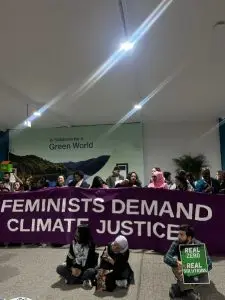
Existing inequalities in access to land, finance, livelihoods and decision-making can heighten the risks faced by women and girls; climate-related crises can also intensify unpaid care work and exposure to gender-based violence. Women are equally essential as leaders in adaptation and resilience.
WILPF UK calls for gender-responsive climate policy and finance, meaningful support for women-led organisations, and implementation of the Belém Gender Action Plan (2026–2034), adopted at COP30.
Women also remain underrepresented in international climate negotiations. The Women’s Environment and Development Organization (WEDO) reported that at COP30 women comprised 40% of Party delegates, 61% of delegations had male majorities, and only 33% of delegations were headed by women. WILPF UK calls on the UK government to field a COP delegation comprising at least 50% women, with parity in senior negotiating and decision-making positions, and to publish its delegation’s gender composition. The UK should also support greater representation of women from climate-vulnerable and conflict-affected communities.
The world is already in trouble
The impact of climate change on countries across the world, but particularly on those in the Global South, has been amply shown in the floods, droughts and forest fires of the last few months. The National Emergency Briefing to UK MPs and peers a year ago highlighted the impacts on the UK and made recommendations for action. The UK Government knows what is coming yet still reduces investment in energy transition and continues to dither about oilfields and airport runways.
Leadership from the UK?
We understand that Andy Burnham will be attending the World Leaders Climate Action Summit on 11-12 November, alongside the relevant ministers. COP31 must establish a credible pathway for a just transition away from coal, oil and gas, one that protects workers and communities, expands access to affordable renewable energy and supports countries that have contributed least to global warming.
WILPF UK urges the UK government to play its part in meeting the climate challenge and show leadership, not least in ending the extraction and expansion of fossil fuels, and in supporting a programme of climate finance for vulnerable communities who have not caused the problem but are most at risk. It must also strengthen its resolve to implement a just transition within the UK, supporting workers and communities affected by the necessary delivery of net zero.